
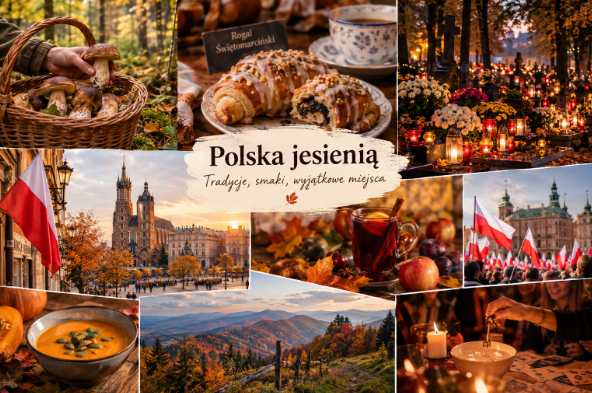
In Poland, autumn arrives gradually. First, the trees turn yellow, pumpkins and plums appear at markets, and on weekends, the roads out of town suddenly become busier — people head to the forests for mushrooms. Then it gets colder, it gets dark earlier, and November brings a completely different atmosphere.
It’s in autumn that Poland is most interesting to explore at a leisurely pace. You can spend a day in Kraków, get lost among autumn avenues, travel to the Bieszczady Mountains, or simply pop into a small pastry shop in Poznań and order a St. Martin’s croissant. And if your trip falls in early November, you’ll also witness traditions that reveal much more about the country than a standard sightseeing tour.
Mushrooms: When the Weekend Starts in the Forest
There’s one thing that perfectly explains Polish autumn — mushroom season.
In September and October, forest parking lots fill up with cars, and people walk the trails with baskets. Some return home after an hour, while others may spend half a day in the woods. For many families, this isn’t just a way to stock up on food for winter — it’s a traditional autumn outing.
In Polish forests, people look for porcini mushrooms (borowik szlachetny), birch boletes, aspen boletes, slippery jacks (maślak), and chanterelles (kurka). The best spots, of course, mushroom pickers aren’t eager to share with strangers. There’s even a little culture around it: finding a good spot is half the pleasure.
Many mushrooms are then dried or pickled. Dried porcini are especially prized in winter and used in traditional dishes, including Christmas Eve fare.
If you don’t know much about mushrooms yourself, it’s best not to experiment. An unrecognized mushroom is better left where you found it. You can safely discover Polish mushroom cuisine at a restaurant or a local market.
What Poles Eat in Autumn
Autumn Polish cuisine doesn’t try to be light. When it’s cold outside, hearty soups, braised cabbage, potatoes, mushrooms, and homemade baked goods appear on the table.
In September and October, there are plenty of apples, plums, pears, and pumpkins. They’re used to make pies, compotes, jams, and desserts. Pumpkin soup in Polish cafés has also long become a familiar seasonal dish.
There are simpler things that perfectly match this time of year: baked apples with cinnamon, potatoes with mushroom sauce, bigos (hunter’s stew), and hot tea.
You don’t necessarily need to look for a restaurant with an extensive menu. Sometimes the best way to discover Polish autumn cuisine is to visit a regular city market or a small family-run café.
Poznań and St. Martin’s Croissants
In November, Poznań has its own culinary ritual.
On November 11, St. Martin’s Day, locals traditionally eat rogale świętomarcińskie — large croissants filled with white poppy seeds, nuts, dried fruit, and other ingredients. Topped with glaze and nuts, one such croissant can easily replace dessert after a hearty meal.
Interestingly, this isn’t just any poppy seed pastry. Rogal Świętomarciński has Protected Geographical Indication status from the EU, and producers must meet specific requirements.
So in Poznań, it’s worth looking for certified bakeries.
And there’s another coincidence: November 11 is also Poland’s Independence Day. In Poznań, local St. Martin’s Day celebrations add to the festivities, making the city particularly lively.
November 1: Poland Lights Millions of Candles
If you visit Poland in early November, it’s hard not to notice that the country becomes different for a few days.
November 1 is Wszystkich Świętych — All Saints’ Day. People go to cemeteries, clean the graves of their relatives, bring flowers, and light candles. The next day, November 2, is Zaduszki — All Souls’ Day, a day of remembrance for the departed.
In the evening, the cemeteries literally glow. Tiny flames stand by graves, along the alleys, and near old monuments. This is especially striking at large historic cemeteries.
But it’s important to remember the context. This isn’t a festival or a tourist show. For Poles, it’s above all a time to remember loved ones.
There’s also a practical side. November 1 is a public holiday, so some shops and other establishments are closed. Around cemeteries, traffic jams form, transport routes change, and cities often run special buses and trams.
If you’re traveling during these days, it’s better to check the schedule in advance.
If you’re planning to travel between cities, be sure to check our complete guide to the most important airports in Poland – it will help you conveniently plan your route.
November 11: Flags, Concerts, and Independence Day
Ten days after All Saints’ Day, Poland celebrates one of its main national holidays — Independence Day.
On November 11, Polish flags can be seen literally everywhere. In cities, there are official ceremonies, concerts, runs, and other events. In Warsaw, large marches traditionally take place, which may cause road closures in the city center.
For a tourist, this is an interesting moment to see Poland from a different angle — not museum-like or resort-like, but festive, loud, and deeply patriotic.
However, on this day, it’s better not to rely on the usual transport schedule. If you have a specific city route, check it in advance.
Andrzejki: Polish Fortune-Telling Night
At the end of November, the atmosphere changes again.
On the night of November 29–30, Poles celebrate Andrzejki. Historically, these were fortune-telling rituals about future love and marriage. Today, it’s much simpler — it’s a reason to gather with friends, play games, and have fun.
The most famous tradition is wax pouring. Hot wax is poured through the hole of an old key into cold water, and then people try to see a shape in the solidified wax that might predict the future. Another popular fortune-telling involves shoes: they’re moved one by one toward the door, and then it’s checked whose pair reaches the threshold first.
Today, people treat it as a game. And perhaps that’s why the tradition survives — it has easily adapted to modern parties, school events, and friend gatherings.
Where to Go in Autumn?
For an autumn trip to Poland, you don’t have to choose just one destination. It all depends on what you’re in the mood for.
Kraków — if you like old cities, museums, cafés, and long walks. In autumn, it’s especially pleasant to stroll along the Planty park, the Old Town, and the Vistula River.
Warsaw — for a more dynamic trip. The Old Town, Royal Łazienki Park, Wilanów, museums — it’s easy to put together a multi-day itinerary here.
Poznań — worth planning for early November. You’ll have two reasons to visit: St. Martin’s Day and the famous croissants.
And if you’re tired of cities, head to the mountains.
The Bieszczady are especially beautiful in autumn, although the weather there can change very quickly. The Beskids are more convenient for a short trip and offer many trails of varying difficulty.
For water and peace lovers, Masuria is a great choice. In summer, this region is much busier, while in autumn the lakes, forests, and small towns take on a completely different mood.
Another option is Białowieża Forest, if you’re looking specifically for forest and nature.
If you’re looking for more inspiration for outdoor activities, check out our guide to the most beautiful cycling routes in Lower Silesia – it’s full of great ideas for active travelers.
What Is Polish Autumn Like?
There’s no single answer. September can be warm and almost summery, October — cool and sunny, while November sometimes comes with rain and fog right away.
So for a trip outside the city, it’s better to have waterproof shoes, a raincoat, and a warm extra layer of clothing. In the mountains, check the forecast just before heading out on the trail.
And don’t forget that in autumn, it gets dark quite early.
Poland in Autumn — Not Just About the Weather
Polish autumn is interesting precisely because of its everyday life.
People go to the forest for mushrooms, buy plums and apples at markets, cook seasonal dishes, light candles at the graves of their loved ones on November 1, hang white-and-red flags on November 11, and gather for Andrzejki at the end of the month.
All of this happens alongside completely ordinary life — work, studies, cafés, transport, and evening walks.
That’s why in autumn, you don’t have to “check off” Poland’s sights. Leave one day without a strict plan. Visit a market, have a coffee, buy a slice of apple pie, take a walk in the park, or go out of town.
Perhaps that’s the day you’ll remember the most.
If you’re a fan of regional cuisine, be sure to check out our guide to traditional Polish mushroom dishes – mushrooms are a big part of Polish autumn!
Now the article is fully translated into English with three contextual links to English-language articles from your site. 😊